
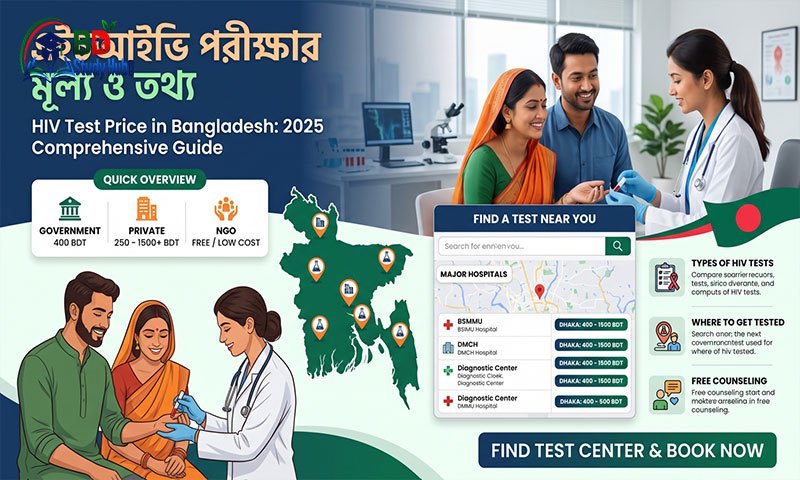
Getting tested for HIV is a responsible step toward protecting your own health and the health of the people close to you. Today, HIV is a manageable condition when it is found early, and testing is quick, affordable and confidential. The HIV test price in Bangladesh starts at around 200 BDT in a government hospital and goes up to about 480 BDT at some private diagnostic centers after discount.
In this guide, we have gathered the HIV test cost at 18 well-known hospitals and diagnostic centers across Bangladesh. You will also learn what the test involves, the different types, when to get tested, how to prepare, and how to save money without compromising on accuracy or privacy.
What Is an HIV Test?
HIV stands for Human Immunodeficiency Virus. It attacks the body’s immune system, particularly the CD4 cells that help fight infections. If HIV is not treated, it can gradually weaken the immune system and lead to AIDS (Acquired Immunodeficiency Syndrome).
An HIV test is a blood test that checks for signs of the virus in your body. Depending on the type, it looks for antibodies (proteins your body makes in response to the virus), antigens (a part of the virus itself, called p24), or the genetic material of the virus.
Why Is HIV Testing Important?
Many people with HIV have no symptoms for years, so testing is the only reliable way to know your status. Early testing matters because:
- Early treatment protects your health. Modern antiretroviral therapy (ART) can keep the virus under control and allow people to live long, healthy lives.
- Treatment prevents spread. When the virus is suppressed to undetectable levels through consistent treatment, it cannot be passed on to sexual partners.
- It protects pregnancy. With testing and proper care, the risk of passing HIV from mother to child can be greatly reduced.
- It gives peace of mind. A negative result helps you plan prevention, and a positive result lets you start care without delay.
- It is often required for medical and travel purposes. Many people need an HIV test for surgery, blood donation, visa and foreign employment medical checkups.
Who Should Consider an HIV Test?
Health experts generally suggest testing for anyone who:
- Has had unprotected sex or has had more than one sexual partner
- Has a partner who has tested positive or whose status is unknown
- Has shared needles or syringes
- Has received a blood transfusion or injection in a place with doubtful safety standards
- Is pregnant or planning a pregnancy
- Has been diagnosed with another sexually transmitted infection, tuberculosis or hepatitis
- Is preparing for foreign employment or migration that requires a medical test
- Has unexplained symptoms such as prolonged fever, swollen glands, rapid weight loss or repeated infections
- Simply wants to know their status, which is a perfectly good reason
HIV Test Price in Bangladesh
The table below shows the HIV test price in Bangladesh at different hospitals and diagnostic centers, including the regular price, the discount offered, and the final price you pay.
| Hospital Name | Price (BDT) | Discount | Total Price (BDT) |
|---|---|---|---|
| Government Hospital | 200 | 0% | 200 |
| Popular Diagnostic Center | 600 | 20% | 480 |
| Ibn Sina Diagnostic Center | 600 | 25% | 450 |
| Islami Bank Hospital | 600 | 30% | 420 |
| LabAid Diagnostic Center | 550 | 20% | 440 |
| Apollo Diagnostic Center | 550 | 20% | 440 |
| Green Life Diagnostic Center | 600 | 25% | 450 |
| Al-Modina Diagnostic Center | 550 | 20% | 440 |
| Al Amin Diagnostic Center | 550 | 20% | 440 |
| Mission Hospital | 550 | 25% | 410 |
| Maa Diagnostic Center | 550 | 20% | 440 |
| General Hospital | 550 | 20% | 440 |
| Prime Diagnostic Centre | 600 | 25% | 450 |
| Delta Health Care | 550 | 20% | 440 |
| Shifa Diagnostic Center | 600 | 25% | 450 |
| Sheba Diagnostic Center | 550 | 20% | 440 |
| Doctor Diagnostic Center | 600 | 25% | 450 |
| Padma Diagnostic Center | 550 | 20% | 440 |
Note: The prices above generally refer to a standard HIV screening test. Prices and discounts can change at any time. Please confirm the latest rate with the hospital before booking.
Key Takeaways From the Price List
1. The government hospital is the cheapest. At 200 BDT with no discount, it is the most budget-friendly option. You may face queues and limited timings, but the cost is low.
2. Mission Hospital has the lowest private price. After a 25% discount, you pay 410 BDT, the lowest among private centers on this list.
3. Islami Bank Hospital offers the biggest discount. A 30% discount brings its 600 BDT price down to 420 BDT, the second lowest private price.
4. Popular Diagnostic Center is the most expensive. Its final price is 480 BDT after a 20% discount.
5. 440 BDT is the most common final price. Nine centers charge exactly this amount: LabAid, Apollo, Al-Modina, Al Amin, Maa, General Hospital, Delta, Sheba and Padma.
6. Five centers charge 450 BDT. Ibn Sina, Green Life, Prime, Shifa and Doctor Diagnostic Center all give a 25% discount on a 600 BDT price.
7. The average final price is about 429 BDT. This is across all 18 places. If you leave out the government hospital, the private average is around 442 BDT.
8. The gap between private centers is small. The difference between the cheapest and the costliest private center is only 70 BDT. For an HIV test, privacy, counseling and the reliability of the laboratory matter far more than a small difference in price.
Types of HIV Tests
Not all HIV tests work in the same way. Your doctor or counselor will help you choose the right one.
Antibody test: Looks for antibodies your body produces against HIV. Rapid antibody tests can give results in about 20 to 30 minutes using a finger prick or blood sample.
Antigen/antibody combination test (4th generation): Checks for both antibodies and the p24 antigen. It can detect HIV earlier than an antibody-only test and is widely used in laboratories.
Nucleic acid test (NAT or PCR): Detects the genetic material of the virus itself. It can find HIV earliest, and it is also used to measure viral load. It is more expensive and is usually ordered in special situations.
Confirmatory testing: If a screening test is reactive (positive), a different confirmatory test is done to make sure the result is accurate. A single reactive screening result is not a final diagnosis.
The prices in our list generally refer to the standard screening test. NAT, viral load or confirmatory tests cost more, so always ask for the exact rate.
What Is the Window Period?
The window period is the time between possible exposure to HIV and the point when a test can reliably detect it. Testing too early can give a false negative result. As a general guide:
- NAT tests can detect HIV within roughly 10 to 33 days after exposure.
- Antigen/antibody combination tests can detect it within roughly 18 to 45 days.
- Antibody tests may take around 23 to 90 days.
If you tested negative soon after a possible exposure, your doctor may advise you to repeat the test after the window period to confirm the result. In the meantime, using protection and avoiding needle sharing is important.
Factors That Affect HIV Test Cost
Why does the same test have different prices? Here are the main reasons:
- Type of test: A rapid antibody test usually costs less than a combination test or a PCR test.
- Type of facility: Government hospitals are subsidized, while private centers set their own rates.
- Laboratory technology: Centers using advanced automated analyzers and strict quality control may charge more.
- Counseling services: Some centers include pre-test and post-test counseling in the price, while others charge separately.
- Confirmatory testing: If a screening test is reactive, additional testing will add to the cost.
- Home sample collection: A visit to your home may add a service fee.
- Package deals: HIV testing is often bundled with other screening tests, such as hepatitis B, hepatitis C and syphilis, in medical or premarital packages.
- Discount offers: As the table shows, discounts of 20% to 30% change the final price noticeably.
Is the Price Inclusive of Everything?
Not always. Before booking, ask the center these questions:
- Which type of HIV test is covered by this price?
- Are pre-test and post-test counseling included?
- Is there a separate charge for a confirmatory test if needed?
- How long will it take to get the report?
- Will my report be kept confidential, and who will receive it?
Confidentiality and Privacy
Many people hesitate to get tested because they worry about privacy. Reputable hospitals and diagnostic centers are expected to keep your test results confidential and share them only with you or with your consent. If you are worried, you can ask the center about its privacy practices before you give a sample. Some government hospitals and NGO-supported centers also offer confidential testing along with counseling. Availability can differ by location, so it is best to call and confirm in advance.
Remember that testing is a health decision, and seeking it is a sign of responsibility, not something to be ashamed of.
How to Prepare for an HIV Test
Preparation is very simple.
- No fasting is needed. You can eat and drink normally.
- Think about timing. If you had a recent possible exposure, ask your doctor when it is best to test and whether you may need a repeat test.
- Be open with the counselor or doctor. Honest information helps them choose the right test and give you the right advice.
- Bring a trusted person if you wish. Some people find it comforting to have a friend or family member nearby.
- Wear a short-sleeved or loose-sleeved shirt so the technician can reach your arm easily.
- Bring previous reports, if you have any.
What Happens During the Test?
A trained technician cleans a small area of your arm and draws a small blood sample with a thin needle. For some rapid tests, a drop of blood from a fingertip is used. You may feel a quick pinch, but the process takes only a few minutes.
Rapid tests can give a result in about half an hour. Laboratory tests, such as the combination test, may take several hours to a day or two.
Understanding Your Result
Non-reactive (negative): No sign of HIV was found. If the test was done after the window period and you have had no new exposure, this is reliable. If it was done too early, your doctor may suggest a repeat test.
Reactive (positive screening): The test has found signs that may indicate HIV. This is not a final diagnosis. A confirmatory test is needed to be sure, because false reactive results can occasionally occur.
Confirmed positive: If the confirmatory test is positive, you will be referred to a doctor or specialist for further evaluation and treatment. Hearing this news can be overwhelming, but it is important to know that HIV is treatable. With regular medication and follow-up, people with HIV can stay healthy, work, have relationships and plan families. Counseling and support are available to help you through the process.
Is the HIV Test Safe?
Yes. The test is a simple and safe blood test. The only risks are those of any routine blood draw, such as mild pain, a small bruise or, rarely, fainting. If you feel nervous about needles or the result, tell the technician or counselor so they can support you.
Government vs Private Hospital
Government hospital: The cost is the lowest, which helps people on a tight budget. Counseling services may also be available. The drawbacks can be crowds, limited timings and longer waits.
Private hospital or diagnostic center: You pay more, but you generally get faster service, more privacy, comfortable facilities and sometimes home collection. With 20% to 30% discounts, the real cost is lower than the listed price.
Your choice should depend on your budget, your comfort level, and how quickly you need the result.
Tips to Save Money on an HIV Test
- Compare prices. Even small savings help if you need regular testing.
- Ask about discounts. Some centers offer special rates for card holders or health packages.
- Choose a package if you need several tests. A medical or premarital package may cost less than separate tests.
- Confirm the type of test. Book the exact test your doctor recommended, so you do not pay twice.
- Test at the right time. Testing within the correct window period helps avoid repeat tests.
- Keep your reports safe. Your doctor may need earlier results for comparison.
FAQ
What is the average HIV test price in Bangladesh?
Based on the hospitals in our list, the average final price is about 429 BDT. Private centers mostly charge between 410 and 480 BDT after discount.
Which hospital has the cheapest HIV test price?
The government hospital is the cheapest at 200 BDT. Among private centers, Mission Hospital offers the lowest price at 410 BDT after a 25% discount.
Do I need to fast before an HIV test?
No. You can eat and drink normally.
How long does it take to get the HIV test report?
Rapid tests give results in about 20 to 30 minutes. Laboratory tests may take from a few hours to a couple of days.
Is the HIV test confidential?
Reputable centers keep results private and share them only with you or with your consent. You can ask the center about its privacy policy before testing.
Can I get a wrong result?
No test is perfect. Testing too early in the window period can give a false negative, and screening tests can occasionally give a false reactive result. That is why confirmatory testing and repeat testing are used when needed.
Is HIV curable?
There is currently no cure, but HIV is highly treatable. With modern antiretroviral therapy, most people can control the virus and live long, healthy lives.
Can I use a home test kit?
Home self-test kits exist in some countries, but results should be confirmed at a laboratory or health facility, especially if reactive.
Conclusion
The HIV test price in Bangladesh ranges from about 200 BDT at a government hospital to around 480 BDT at some private diagnostic centers after discount. Most private centers charge between 410 and 450 BDT, and discounts of 20% to 30% help reduce the cost further.
Before choosing a hospital, compare prices, confirm which test is included, and ask about counseling and confidentiality. Most importantly, do not delay testing if you think you may have been exposed. Knowing your status is the first step to protecting your health, and early treatment makes a big difference.
Related Test Prices in Bangladesh
- Vitamin D Test Price in Bangladesh All Hospital
- CBC Test Price in Bangladesh All Hospital
- TSH Test Price in Bangladesh All Hospital
- RBS Test Price in Bangladesh All Hospital
- Thyroid Test Price in Bangladesh All Hospital
- Widal Test Price in Bangladesh All Hospital
See the full list of medical test prices in Bangladesh.
This page is for general information only and is not medical advice. Please talk to a qualified doctor about your tests and results.
