
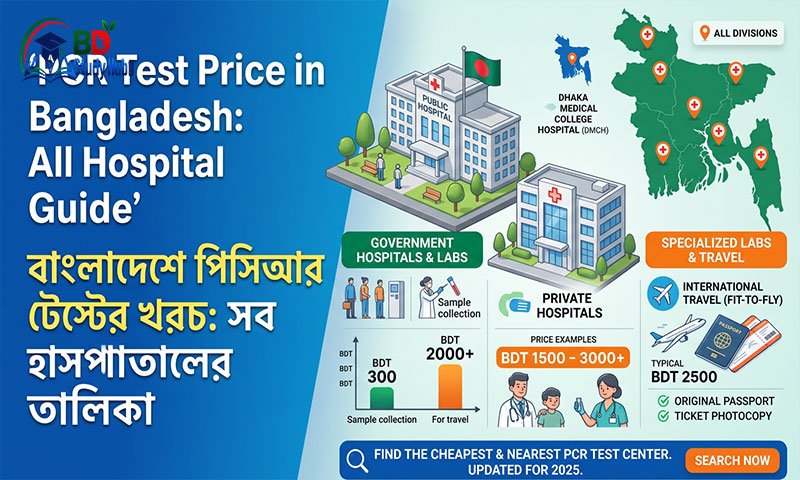
PCR is one of the most accurate laboratory methods for detecting infections. Since the COVID-19 pandemic, most people in Bangladesh have heard of it, but it is also used for travel, hospital admission, surgery and the diagnosis of many other infections. The PCR test price in Bangladesh starts at around 1,500 BDT in a government hospital and goes up to about 4,400 BDT at some private diagnostic centers after discount.
In this guide, we have gathered the PCR test cost at 18 well-known hospitals and diagnostic centers across Bangladesh. You will also learn what a PCR test is, how it works, when it is needed, how to prepare, and how to save money without compromising on accuracy.
What Is a PCR Test?
PCR stands for Polymerase Chain Reaction. It is a laboratory technique that finds the genetic material (DNA or RNA) of a germ, such as a virus or bacterium, in a sample taken from your body. If even a tiny amount of the germ’s genetic material is present, the PCR machine copies it millions of times until it is easy to detect. This is why PCR is considered highly sensitive and reliable.
For viruses with RNA, such as the coronavirus, laboratories use a version called RT-PCR (Reverse Transcription PCR). It first converts RNA into DNA and then copies it. The prices in our list generally refer to a standard RT-PCR test for a respiratory infection such as COVID-19. Other PCR tests may cost more, so always confirm the exact test and rate with the hospital.
Where Is PCR Testing Used?
PCR is used far beyond COVID-19. Doctors and laboratories use it to:
- Detect respiratory viruses such as COVID-19, influenza and RSV
- Diagnose infections like hepatitis B and hepatitis C (viral load and HCV RNA)
- Detect tuberculosis and check for drug resistance (for example, GeneXpert)
- Test for HIV viral load
- Detect sexually transmitted infections
- Identify bacterial and fungal infections in blood, urine, stool or other samples
- Check for dengue and other viral fevers in some cases
- Run genetic and inherited disease tests
- Support cancer and tumor profiling
- Match samples in DNA and forensic work
This wide use is one reason prices differ so much from one PCR test to another.
Why Might You Need a PCR Test?
You might be asked to take a PCR test if:
- You have symptoms such as fever, cough, sore throat, loss of taste or smell, body ache or breathing difficulty, and your doctor wants a confirmed diagnosis
- You have been in close contact with a person who has tested positive
- You are about to be admitted to a hospital or are planning surgery
- You need a negative report for international travel, a visa, foreign employment or another official requirement
- You are a healthcare worker, or you work in a place where regular screening is required
- Your doctor needs to confirm an infection found on a screening test
- You are being monitored during or after treatment for certain infections
PCR Test Price in Bangladesh
The table below shows the PCR test price in Bangladesh at different hospitals and diagnostic centers, including the regular price, the discount offered, and the final price you pay.
| Hospital Name | Price (BDT) | Discount | Total Price (BDT) |
|---|---|---|---|
| Government Hospital | 1,500 | 0% | 1,500 |
| Popular Diagnostic Center | 5,500 | 20% | 4,400 |
| Ibn Sina Diagnostic Center | 5,500 | 25% | 4,100 |
| Islami Bank Hospital | 5,000 | 30% | 3,500 |
| LabAid Diagnostic Center | 5,000 | 20% | 4,000 |
| Apollo Diagnostic Center | 5,000 | 20% | 4,000 |
| Green Life Diagnostic Center | 5,000 | 25% | 3,750 |
| Al-Modina Diagnostic Center | 5,000 | 20% | 4,000 |
| Al Amin Diagnostic Center | 5,000 | 20% | 4,000 |
| Mission Hospital | 5,000 | 25% | 3,750 |
| Maa Diagnostic Center | 5,000 | 20% | 4,000 |
| General Hospital | 5,000 | 20% | 4,000 |
| Prime Diagnostic Centre | 5,000 | 25% | 3,750 |
| Delta Health Care | 5,000 | 20% | 4,000 |
| Shifa Diagnostic Center | 5,000 | 25% | 3,750 |
| Sheba Diagnostic Center | 5,000 | 20% | 4,000 |
| Doctor Diagnostic Center | 5,000 | 25% | 3,750 |
| Padma Diagnostic Center | 5,000 | 20% | 4,000 |
Note: Prices and discounts can change at any time. Please confirm the latest rate and the exact type of PCR test with the hospital before booking.
Key Takeaways From the Price List
1. The government hospital is the cheapest. At 1,500 BDT with no discount, it is the most budget-friendly option. However, availability can be limited, and the process may involve official procedures and longer waiting times.
2. Islami Bank Hospital has the lowest private price. Thanks to a 30% discount, its 5,000 BDT price drops to 3,500 BDT.
3. Popular Diagnostic Center is the most expensive. Its regular price is 5,500 BDT, and even after a 20% discount you pay 4,400 BDT.
4. 4,000 BDT is the most common final price. Nine centers charge exactly this amount: LabAid, Apollo, Al-Modina, Al Amin, Maa, General Hospital, Delta, Sheba and Padma.
5. Five centers charge 3,750 BDT. Green Life, Mission Hospital, Prime, Shifa and Doctor Diagnostic Center all give a 25% discount on a 5,000 BDT price.
6. Ibn Sina charges 4,100 BDT. It lists the test at 5,500 BDT and gives a 25% discount.
7. The average final price is about 3,792 BDT. This is across all 18 places. If you leave out the government hospital, the private average is around 3,926 BDT.
8. The gap between private centers is about 900 BDT. The difference between the cheapest private price (3,500 BDT) and the costliest (4,400 BDT) is meaningful, so comparing can save you a good amount. Even so, the accuracy of the lab and the validity of the report for your purpose should come first.
Factors That Affect PCR Test Cost
Why does the same test have different prices? Here are the main reasons:
- Type of PCR test: A COVID-19 RT-PCR costs differently from a hepatitis C viral load, TB PCR or a genetic PCR test.
- Type of facility: Government hospitals are subsidized, while private hospitals and diagnostic centers set their own rates.
- Laboratory technology: PCR needs expensive machines, special reagents and trained scientists, and the quality of these affects the price.
- Number of targets tested: Some panels check for several germs at once, which costs more.
- Report speed: Same-day or urgent reports often cost extra.
- Sample collection: A home visit by a technician may add a service charge.
- Travel or official reports: Reports for travel or visas may need a specific format, QR code or certification, which can add to the cost.
- Discount offers: As the table shows, discounts of 20% to 30% change the final price noticeably.
Is the Price Inclusive of Everything?
Not always. Before booking, ask the hospital these questions:
- Which PCR test is covered by this price?
- Does the price include sample collection and the final report?
- Is there an extra charge for a home visit?
- How many hours or days will the report take?
- Is there an extra fee for an urgent or express report?
- Will the report be accepted for my purpose, such as travel, a visa or surgery?
Clear answers will help you avoid surprise charges.
How to Prepare for a PCR Test
Preparation depends on the type of sample, but these general tips apply.
For a nose or throat swab (respiratory PCR):
- Avoid eating, drinking, smoking or chewing gum for about 30 minutes before a throat or saliva sample.
- Do not use nasal sprays, mouthwash or throat lozenges just before the test unless your doctor says it is fine.
- Wear a mask until the moment of sample collection and follow the center’s safety rules.
For a blood PCR test:
- Fasting is usually not needed, but ask the laboratory when you book.
- Drink water normally.
- Wear a short-sleeved or loose-sleeved shirt.
For all PCR tests:
- Tell your doctor or technician about your symptoms, when they began and any recent contact with an infected person.
- Mention any medicines or recent treatment that may affect the test.
- Bring a valid ID, especially for travel or official reports.
- Bring previous reports and your doctor’s prescription or request.
What Happens During the Test?
For a respiratory PCR test, a trained technician in protective gear gently inserts a thin, soft swab into your nose, throat or both. It may feel uncomfortable or tickly, and some people cough or have watery eyes for a moment, but it takes only a few seconds. In some cases, a saliva sample is used instead.
For other PCR tests, the sample may be blood, urine, stool, sputum, or another body fluid. The sample is sealed, labeled and sent to the laboratory, where scientists extract the genetic material and run it through the PCR machine.
How Long Does It Take to Get the Result?
The time depends on the type of test and the laboratory. Many respiratory PCR results are ready within about 6 to 24 hours, while some centers may take up to a few days. Specialized PCR tests, such as viral load tests or genetic panels, can take longer. If you need the report urgently for travel or admission, ask about express options when you book.
Understanding Your PCR Result
Not detected (negative): No genetic material of the germ was found in the sample. This usually means you do not have the infection, but a very early infection or a poor sample can sometimes be missed. If your symptoms continue, your doctor may repeat the test.
Detected (positive): The germ’s genetic material was found, which means you are likely infected. Your doctor will advise you on treatment, isolation and follow-up.
Inconclusive or invalid: The test could not give a clear result, often because the sample was not good enough. A repeat sample is needed.
Some reports also show a Ct (cycle threshold) value. A lower Ct value generally means more of the germ is present, but Ct values depend on the laboratory and method and should be interpreted only by a doctor. Please do not diagnose or treat yourself based on the report alone.
How Accurate Is a PCR Test?
PCR is considered one of the most accurate tests available for detecting many infections. It can find very small amounts of genetic material. However, no test is perfect. Results can be affected by:
- Timing: Testing too early after exposure may miss the infection.
- Sample quality: A poorly collected swab or an old sample may give a wrong result.
- Handling and laboratory errors: These are rare in good laboratories but can happen.
- Remaining genetic material: After recovery, PCR may stay positive for some time, even when a person is no longer infectious.
Choosing a reliable, well-equipped laboratory improves the accuracy of your result.
Is the PCR Test Safe?
Yes. A PCR test is safe. A nose or throat swab may cause brief discomfort or a mild tickle, and a small nosebleed is rare. A blood sample carries only the usual minor risks of a routine blood draw, such as mild pain or a small bruise. If you are anxious about swabs or needles, tell the technician so they can help you stay comfortable.
Government vs Private Hospital
Government hospital: The cost is much lower, which is very helpful for patients on a tight budget. The drawbacks can be limited availability, crowds, official formalities and longer waiting times.
Private hospital or diagnostic center: You pay more, but you generally get faster service, comfortable facilities, flexible timing and sometimes home sample collection. With discounts of 20% to 30%, the real cost is lower than the listed price.
Your choice should depend on your budget, the urgency of the test and the purpose of the report, for example, whether it must be accepted by an airline, embassy or employer.
Tips to Save Money on a PCR Test
- Compare prices. With a gap of about 900 BDT among private centers, comparing can save real money.
- Ask about discounts. Some centers offer special rates for card holders, groups, senior citizens or families.
- Skip express service unless needed. Standard reporting is usually cheaper.
- Confirm the report format. If you need the report for travel or a visa, make sure the format is acceptable so you do not need to pay for a second test.
- Book only the tests advised. Follow your doctor’s list to avoid unnecessary panels.
- Time the test correctly. Testing too early can mean paying for a repeat test.
- Keep your reports safe. Old reports help doctors compare results and prevent repeat testing.
FAQ
What is the average PCR test price in Bangladesh?
Based on the hospitals in our list, the average final price is about 3,792 BDT. Private centers mostly charge between 3,500 and 4,400 BDT after discount.
Which hospital has the cheapest PCR test price?
The government hospital is the cheapest at 1,500 BDT. Among private centers, Islami Bank Hospital offers the lowest price at 3,500 BDT after a 30% discount.
Do I need to fast before a PCR test?
Usually no. For a nose or throat swab, avoid eating, drinking or smoking for a short time before the test, as the laboratory instructs.
How long does it take to get the PCR report?
Many respiratory PCR reports are ready within 6 to 24 hours, while specialized PCR tests can take longer.
Is the PCR test painful?
Not usually. A nose or throat swab can be uncomfortable for a few seconds, and a blood sample causes only a brief pinch.
Is PCR more accurate than a rapid test?
In general, PCR is more sensitive than rapid antigen tests because it can detect very small amounts of genetic material. Rapid tests are quicker but may miss early or mild infections.
Can I use a PCR report for travel?
It depends on the destination’s rules and the airline’s requirements. Check the accepted test type, timing and report format before you book, and confirm that the laboratory can provide it.
Can PCR stay positive after I recover?
Yes. In some infections, PCR can remain positive for weeks because it detects leftover genetic material. Your doctor will guide you on how to interpret this.
Conclusion
The PCR test price in Bangladesh ranges from about 1,500 BDT at a government hospital to around 4,400 BDT at some private diagnostic centers after discount. Most private centers charge either 3,750 or 4,000 BDT, and Islami Bank Hospital offers the lowest private price at 3,500 BDT.
Before choosing a hospital, compare prices, confirm exactly which PCR test is included, and check whether the report format suits your purpose. Most importantly, if you have symptoms or a possible exposure, do not delay testing. An accurate PCR result helps you and your doctor take the right steps early, protect your family and make confident decisions about treatment or travel.
Related Test Prices in Bangladesh
- Lipid Test Price in Bangladesh All Hospital
- ECG Test Price in Bangladesh All Hospital
- Serum Creatinine Test Price in Bangladesh All Hospital
- TVS Test Price in Bangladesh All Hospital
- Uric Acid Test Price in Bangladesh All Hospital
- Vitamin D Test Price in Bangladesh All Hospital
See the full list of medical test prices in Bangladesh.
This page is for general information only and is not medical advice. Please talk to a qualified doctor about your tests and results.
